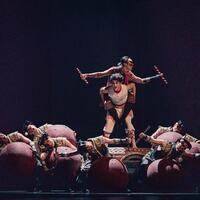


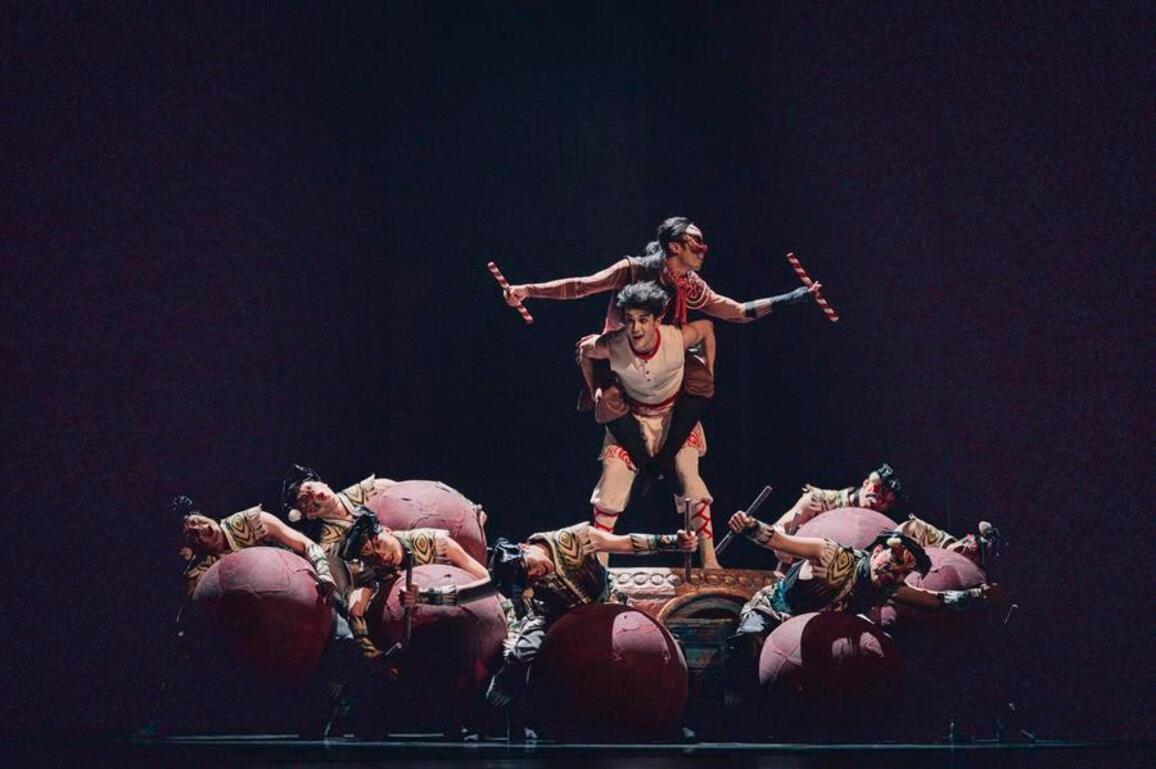
BEIJING, June 9 (Xinhua) -- On a recent summer night, as the classic Chinese drama "Rickshaw Boy" took the stage at the Beijing People's Art Theater, nine high-definition cameras and 17 audio tracks streamed every detail of the performance to a broader audience.
Nearly 6,000 students and faculty members across eight universities in the Beijing-Tianjin-Hebei region in north China watched the same play on campus screens in real time, experiencing the dust and drama of old Beijing as if they were sitting in the front row of the theater.
"Technology takes fine art beyond the theater to embrace more audiences," said Kang Xiyue, a student at Nankai University in Tianjin Municipality, before enjoying the live screening. "That is very meaningful," Kang added.
"From stage to screen, quality artistic resources are now being shared across regions," said Feng Yuanzheng, president of the Beijing People's Art Theater.
The new presentation format has filled the gap for those unable to attend live performances and expanded the theater's reach by breaking out of its traditional niche, Feng noted.
This initiative comes at a time when China is striving to make public cultural resources more accessible and equitable for all, a commitment written in the country's ongoing 15th Five-Year Plan.
Theaters across China are racing to produce their own high-definition stage recordings. The National Theater of China, the National Center for the Performing Arts and the Northern Kunqu Opera Theater have all released high-definition video versions of their classic productions.
In the past, theater was often seen as a niche art form in China. Live performance and limited seating meant it could never achieve the mass reach of film or television.
But since the country introduced high-definition theater screenings from Britain nearly two decades ago, such fine art is no longer confined to the stage, benefiting audiences who once had no access to top-tier performances.
A program jointly launched by Chinese and British theaters in 2015 had brought high-definition stage art screenings to 69 Chinese cities as of March 2024. It had screened more than 250 productions in over 10,000 shows, attracting more than 800,000 viewers in China. Its offerings include a wide range of excellent plays from countries such as Britain, the United States, France and Russia.
"It was such a pleasant surprise to be able to embrace world-class productions in China through technology, particularly with every subtle expression and detail magnified on screen," said actor Jiao Gang, an enthusiast of high-definition theater screenings.
Jiao's opinion is shared by Yi Ren, another viewer who believes the new format will surely bring more Chinese people into contact with the theater. "These high-definition stage screenings are really good value for money. Multi-camera, multi-angle shots enable the audience to see every character more clearly than from a fixed theater seat," Yi said.
High-definition stage art screenings, experts say, are like putting every viewer in the best seat in the theater. For about the price of an IMAX ticket, viewers can enjoy a show that would cost several times more to see live.
Behind this enhanced viewing experience lies technological innovation. "Recording standards keep rising, from high-definition to 2K, 4K and now even 8K," said Li Dong, a producer at the National Theater of China.
"While high-definition screens and Dolby audio make the stage look and sound real on screen, better transmission, especially 5G, allows live broadcasts around the globe," Li added, highlighting that China is already at the forefront of 5G transmission worldwide.
According to Li, high-definition stage art screenings carry positive implications for cross-cultural communication. "Putting on a full production of Chinese opera overseas is extremely expensive. But now high-definition screenings in international theaters, paired with talks and demonstrations by opera performers, allow the charm of traditional Chinese culture to be preserved, shared repeatedly and delivered at a lower cost," he said.
In China, experts are often invited to give pre-show or intermission lectures during high-definition stage art screenings. For literary critic Cheng Hui, professional commentary allows audiences to grasp the content of plays more accurately and effectively.
This is especially true for works from different cultural backgrounds or those with avant-garde styles. It enables audiences to fully understand what they're watching -- and that, in turn, helps theater reach further and deeper, Cheng said.
He also explained that high-definition stage art screenings often feature carefully selected outstanding productions, carrying advanced performance techniques and ideas of their time. They are, in themselves, cultural symbols worth preserving and sharing.
At this year's Beijing International Film Festival, the Chinese version of "The Caine Mutiny Court-Martial" by the Beijing People's Art Theater was screened in 4K film, becoming the fastest-selling title of the festival.
In the future, the theater will continue to invest in high-definition screenings and produce two to three drama films each year. The aim, explained its president, Feng, is to preserve high-quality stage productions on film and extend the reach of Chinese theater.