

Welcome to Wider Europe, RFE/RL's newsletter focusing on the key issues concerning the European Union, NATO, and other institutions and their relationships with the Western Balkans and Europe's Eastern neighborhoods.
I'm RFE/RL Europe Editor Rikard Jozwiak, and this week I am drilling down on two issues: a damning rule-of-law verdict for Serbia and the latest Franco-German EU enlargement proposal.
Embed
share
Wider Europe Briefing: Brussels Slams Serbia's Rule Of Law Shortfall
byRFE/RL
Embed
share
The code has been copied to your clipboard.
The URL has been copied to your clipboard
No media source currently available
0:00
0:10:16
0:00
Direct link
128 kbps | MP3
64 kbps | MP3
Pop-out player
Briefing #1: A Damning Report On Serbia
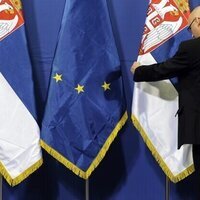
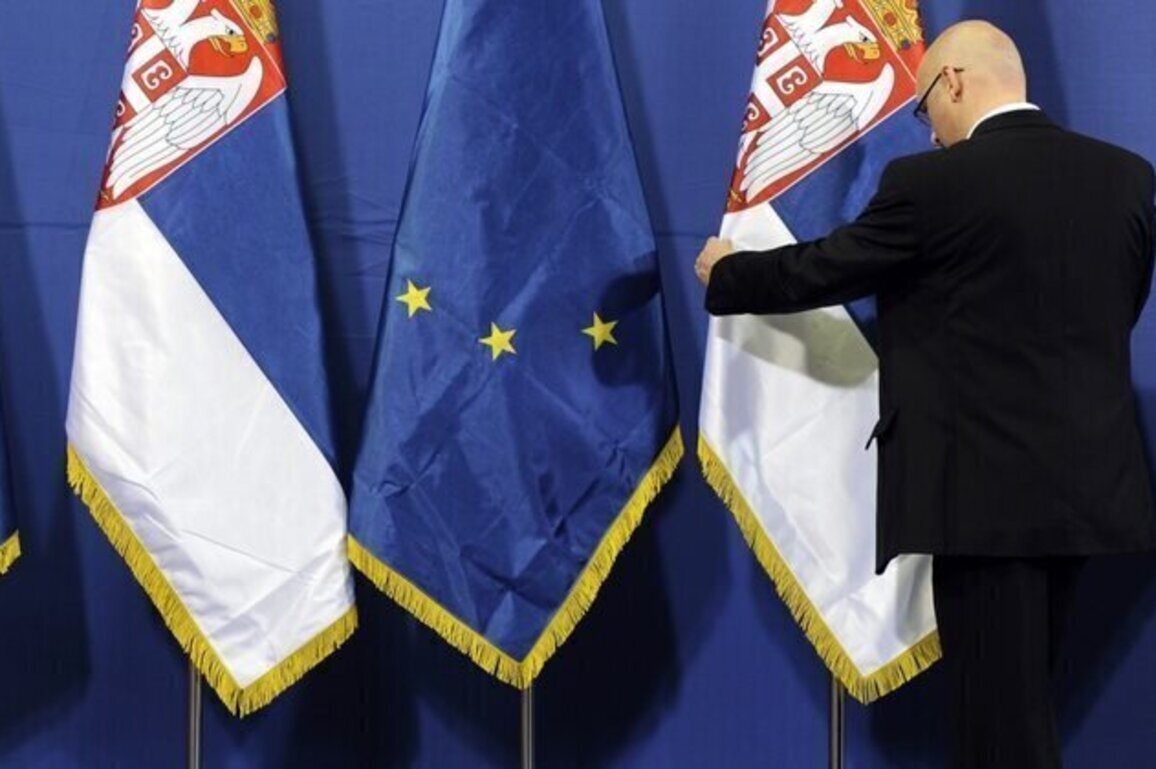
What You Need To Know:The European Commission has produced a damning report on the lack of progress made on issues concerning the rule of law in Serbia.
The annual progress report, seen by RFE/RL, was shared with EU member states in late May and indicates that there has been little or no progress in areas such as the fight against corruption, media freedom, and the functioning and independence of the countrys judiciary.
The report tracks the efforts made by Belgrade in EU accession chapters 23 and 24, which deal with how closely an EU candidate country aligns with the blocs rules and regulations with respect to justice and fundamental rights.
The internal document is produced each spring for Serbia, as well as Montenegro, and always comes halfway between the European Commissions yearly enlargement reports in the autumn, which assess progress across all policy areas in countries seeking EU membership.
Deep Background: The idea is that this document is supposed to guide current member states in assessing how well (or how badly) some countries are doing in what Brussels regards as the two most complicated negotiation blocks.
But while Montenegro is streaming ahead, with the aim of becoming EU member state No. 28 by 2028, Serbia has stood still since late 2021.
This is largely down to the fact that many of the Russia hawks in the bloc are unhappy with Belgrade not aligning with EU sanctions on Moscow since the full-scale invasion of Ukraine in early 2022. There are also doubts about the rule of law in the Balkan country.
And the latest report -- possibly the harshest Brussels has issued on Serbia in years -- will do the country no favors.
Drilling Down
- Perhaps the most critical assessment in the 16-page document concerns the media environment, with the text noting that the number of attacks and cases of pressure against journalists increased and were not consistently condemned by the authorities, including physical attacks, some of which took place in the presence of police who did not respond.
- It adds that female journalists are particularly vulnerable to threats and attacks, especially online, and that several verbal attacks by high-level officials against reporters persisted and have a chilling effect on freedom of expression.
- The picture is equally grim when it comes to the judiciary. The document states that political pressure on the judiciary and the prosecution services, including in relation to prosecution of high-profile cases, has significantly increased, while there is limited follow-up by relevant institutions to address and ensure accountability for such instances of interference.
- It notes that government officials, sometimes at the highest levels, make undue public comments on ongoing investigations or court proceedings, including on the work of individual prosecutors and judges.
- Other issues highlighted include the absence of a court case management system linking courts and prosecutors across the country, an uneven distribution of workload among judges, and the failure to pass several laws aimed at strengthening the judiciary's independence and transparency.
- There is a similar story when it comes to the fight against corruption. The document says that the current law on corruption prevention is generally well-designed but adds that it doesnt extend to all high-ranking public officials and that there is a lack of enforcement and no proper verification of asset declarations.
- There has also not been any progress in a number of large-scale corruption cases, including the investigation into the canopy collapse at the Novi Sad railway station in 2024, which killed 16 people.
- The text also covers the processing of war crimes from the Yugoslav wars of the 1990s. Here, it just notes that Belgrades track record has not improved, citing a staggering backlog of 1,731 pre-investigative cases.
- The countrys judiciary has, according to the text, failed to include financial compensation for war crime victims in any criminal proceedings, while 7,608 people are still missing due to the conflict. There has also been no progress in terms of cooperation with both Croatia and Kosovo on this matter.
- In fact, the only positive remarks in the text are that Serbia cooperates effectively with Brussels in housing irregular migrants trying to get into the bloc in various reception and transit centers, and that Belgrade is working well with Europol in the fight against organized crime groups, notably drug traffickers.
Briefing #2: Will A French-German Proposal Really Speed Up EU Enlargement?
What You Need To Know:Rarely does a week go by in Brussels these days without new ideas and proposals for European Union enlargement.
With Ukraine and Moldova set to open accession talks next week, Montenegro aiming to conclude its negotiations this year, and Iceland due to hold a referendum in August on resuming talks suspended more than a decade ago, EU enlargement is no longer an issue that only preoccupies a few European Commission officials and some diplomats from (mainly) eastern member states as has been the case in recent decades.
Last month, France and Germanyproduced separate discussion paperson how to deal with EU enlargement going forward and on June 4 Berlin and Paris circulated a joint text, seen by RFE/RL, called A New Momentum For Enlargement. The document was meant to provide food for thought ahead of last weeks EU-Western Balkans summit and theupcoming EU-Moldova meeting.
Deep Background:The key premise of the latest France-German three-pager is to complete the Union as a truly European Union adding that to turn this aspiration into reality and to inject a new dynamism, we must provide additional incentives as part of a merit-based, gradual integration process and streamline the current process to make it more efficient and to allow for faster and deeper integration into the EU.
The concept of gradual integration is hardly new. Candidate countries are already being drawn into parts of the EU system before accession, through preferential market access, participation in programs such as the Erasmus student exchange scheme, and initiatives including the EUs roaming-free mobile phone area and the Single Euro Payments Area (SEPA), which allows cross-border euro payments to be processed as easily as domestic transfers.
As was the case with other recent discussion papers that preceded this one, it also includes the threat of reversibility, allowing for integration gains to be rolled back in case of backsliding of the relevant candidate country in its reform process and with regard to the EU core values and principles.
In practice, this has usually meant the loss of EU funding or delays in the accession process. The former has already happened, while the latter has become commonplace regardless of backsliding, as member states have repeatedly vetoed enlargement decisions for a variety of reasons. And given that no country has joined the EU since Croatia back in 2013, this has not been much of a threat up to now.
Drilling Down
- The biggest worry about these papers, however, is that all the ideas and proposals arent really meant to boost candidate countries hopes of joining the club, but are actually creating some sort of more comfortable waiting room as one official from a candidate country put it to RFE/RL, or worse, a sort of second-tier membership.
- The joint text insists that the end goal remains unchanged: full EU membership remains unaffected, our intention is neither to replace full EU membership nor to prolong the path towards it but the opposite: We want to create incentives which foster swifter progress on that path.
- While it is true that the EU might be about to expand again, it is also true that many member states dont want this to happen too quickly given that the blocs common budget will likely need to be expanded -- something that net contributors arent too keen on -- and also because the European Union itself will need to undergo structural reforms, which tend to be very complicated to agree on.
- A key indication of this came from newly elected Hungarian Prime Minister Peter Magyar, who recentlyannounced on Xthat Hungary and Ukraine had reached an agreement on minority rights that would allow Kyiv to start accession talks. He also suggested that Ukraine's path to EU membership could take 10-15 years.
- And while Kyiv and many other prospective EU members still hope for some sort of fast-track route into the club, most Brussels officials quietly contend that the blocs expansion is unlikely to materialize until well into the 2030s.
- Interestingly, the Franco-German document is aimed at Moldova and the five EU hopefuls in the Western Balkans -- Albania, Bosnia-Herzegovina, Kosovo, North Macedonia, and Serbia.
- Montenegro is assumed to be exempt as it will likely join the bloc before the end of the decade.
- Ukraine is not mentioned at all. Nor are Turkey, another major candidate country, or potential candidates such as Iceland.
- In a previous document, Germany had suggested an associate membership model for Ukraine while it waits for full membership. Under the proposal, Kyiv would gain a role in EU institutions -- including through associate commissioners without portfolios and associate members of the European Parliament -- as well as a presence on councils where member states meet, albeit without voting rights.
- The new, Franco-German offer for Moldova and the five Western Balkan candidates is somewhat less generous on the institutional front. It doesnt suggest membership without a vote but rather joint meetings of the European Commission/Members of the European Parliament with representatives of the Western Balkans countries and Moldova each twice a year.
- Another suggestion is to hold more frequent joint parliamentary committees composed of members of the European Parliament and national parliamentarians from the Western Balkans countries and Moldova.
- The candidate countries would also be allowed to participate in informal EU summits and council meetings as observers without the right to vote, such as the monthly gathering of the blocs foreign ministers.
Looking Ahead
There will be quite a lot of Russia sanctions in the works in Brussels this week.
First, the European Commission is set to share its proposal for the blocs 21st round of sanctions on June 9.
With Hungary no longer blocking everything, the key thing to look at now is whether Russian Patriarch Kirill will be included and whether some oligarchs that have already been de-listed due to Hungary, such as Moshe Kantor, will be proposed for blacklisting again.
The following day, on June 10, the blocs ambassadors will alsoapprove more sanctionson military companies helping the Russian war machine as well as firms supporting the Kremlins shadow fleet.
That's all for this week! Feel free to reach out to me on any of these issues on X @RikardJozwiak, or via e-mail [email protected].
Until next time,
Rikard Jozwiak
If you enjoyed this briefing and don't want to miss the next edition subscribehere.
Wider Europe Briefing: Brussels Slams Serbia's Rule Of Law Shortfall
ShareCopy link
Facebook
X (Twitter)
LinkedIn
Email
Share
ShareCopy link
Facebook
X (Twitter)
LinkedIn
Email
Share
Follow usFacebook
X (Twitter)
Youtube
Instagram
Follow us